• Archives
  • Products
  • Operative Dentistry
  • Dental Team Communication
  • Practice Management
  • News
  • Research
  • Dental Debates

DentalBuzz: a jolt of current

trends, innovations, and quirks of dentistry

  • Home – Latest Buzz
  • Bloglist
  • Indie Dental Showcase
  • Free Dental Timer
  • Practice printables
  • Podcasts

Toothpaste can do more harm than good

December 30, 2014 By Trish Walraven 77 Comments

wrongTP

The next time a patient innocently asks me, “What’s the best toothpaste to use?” I’m going to unleash a whole Chunky Soup can of “You Want The Truth? You CAN’T HANDLE THE TRUTH!!!” Gosh, that’s such an overused movie quote. Sorry about that, but still.

If you’re a dental professional, isn’t this the most annoying question you get, day after day? Do you even care which toothpaste your patients use?

No. You don’t. Asking a dentist what toothpaste to use is like asking your physician which bar of soap or body scrub you should use to clean your skin. Your dentist and dental hygienist have never seen a tube of toothpaste that singlehandedly improves the health of all patients in their practice, and the reason is simple:

Toothpaste is a cosmetic.

We brush our teeth so that out mouths no longer taste like… mouth. Mouth tastes gross, right? It tastes like putrefied skin. It tastes like tongue cheese. It tastes like Cream of Barf.

On the other hand, toothpaste has been exquisitely designed to bring you a brisk rush of York Peppermint Patty, or Triple Cinnamon Heaven, or whatever flavor that drives those tubes off of the shelves in the confusing dental aisle of your local supermarket or drugstore.
yuckpaste

Toothpaste definitely tastes better than Cream of Barf. And that’s why you use it. Not because it’s good for you. You use toothpaste because it tastes good, and because it makes you accept your mouth as part of your face again.

From a marketing perspective, all of the other things that are in your toothpaste are in there to give it additional perceived value. So let’s deconstruct these ingredients, shall we?
cavprotecttooth

1. Fluoride.

This was probably the first additive to toothpaste that brought it under the jurisdiction of the Food & Drug Administration and made toothpaste part drug, part cosmetic. Over time, a fluoride toothpaste can improve the strength of teeth, but the fluoride itself does nothing to make teeth cleaner. Some people are scared of fluoride so they don’t use it. Their choice. Professionally speaking, I know that the benefits of a fluoride additive far outweigh the risks.

2. Foam.

Sodium Lauryl Sulfate is soap. Soap has a creamy, thick texture that American tongues especially like and equate to the feeling of cleanliness. There’s not enough surfactant, though, in toothpaste foam to break up the goo that grows on your teeth. If these bubbles scrubbed, you’d better believe that they would also scrub your delicate gum tissues into a bloody pulp.

3. Abrasive particles.

Most toothpastes use hydrated silica as the grit that polishes teeth. You’re probably most familiar with it as the clear beady stuff in the “Do Not Eat” packets. Depending on the size and shape of the particles, silica is the whitening ingredient in most whitening toothpastes. But whitening toothpaste cannot get your teeth any whiter than a professional dental polishing, because it only cleans the surface. Two weeks to a whiter smile? How about 30 minutes with your hygienist? It’s much more efficient and less harsh.

4. Desensitizers.

Teeth that are sensitive to hot, cold, sweets, or a combination can benefit from the addition of potassium nitrate or stannous fluoride to a toothpaste. This is more of a palliative treatment, when the pain is the problem. Good old Time will usually make teeth feel better, too, unless the pain is coming from a cavity. Yeah, I’m talking to you, the person who is trying to heal the hole in their tooth with Sensodyne.

5. Tartar control.

It burns! It burns! If your toothpaste has a particular biting flavor, it might contain tetrasodium pyrophosphate, an ingredient that is supposed to keep calcium phosphate salts (tartar, or calculus) from fossilizing on the back of your lower front teeth. A little tartar on your teeth doesn’t harm you unless it gets really thick and you can no longer keep it clean. One problem with tartar control toothpastes is that in order for the active ingredient to work, it has to be dissolved in a stronger detergent than usual, which can affect people that are sensitive to a high pH.

6. Triclosan.

This antimicrobial is supposed to reduce infections between the gum and tooth. However, if you just keep the germs off of your teeth in the first place it’s pretty much a waste of an extra ingredient. Its safety has been questioned but, like fluoride, the bulk of the scientific research easily demonstrates that the addition of triclosan in toothpaste does much more good than harm.

Why toothpaste can be bad for you.

Let’s just say it’s not the toothpaste’s fault. It’s yours. The toothpaste is just the co-dependent enabler. You’re the one with the problem.

Remember, toothpaste is a cosmetic, first and foremost. It doesn’t clean your teeth by itself. Just in case you think I’m making this up I’ve included clinical studies in the references at the end of this article that show how ineffective toothpaste really is.
peasized

• You’re using too much.

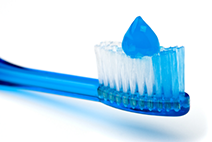
Don’t be so suggestible! Toothpaste ads show you how to use up the tube more quickly. Just use 1/3 as much, the size of a pea. It will still taste good, I promise! And too much foam can make you lose track of where your teeth actually are located.

• You’re not taking enough time.

At least two minutes. Any less and you’re missing spots. Just ’cause it tastes better doesn’t mean you did a good job.

• You’re not paying attention.

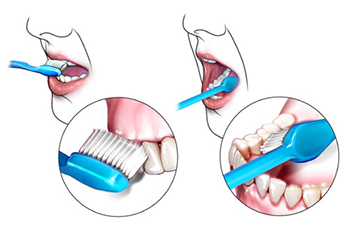
I’ve seen people brush the same four spots for two minutes and miss the other 60% of their mouth.brushguide The toothbrush needs to touch every crevice of every tooth, not just where it lands when you go into autopilot and start thinking about what you’re going to wear that day. It’s the toothbrush friction that cleans your teeth, not the cleaning product. Plaque is a growth, like the pink or grey mildew that grows around the edges of your shower. You’ve gotta rub it off to get it off. No tooth cleaning liquid, paste, creme, gel, or powder is going to make as much of a difference as your attention to detail will.
The solution.

Use what you like. It’s that simple. If it tastes good and feels clean to you, you’ll use it more often, brush longer, feel better, be healthier.

You can use baking soda, or coconut oil, or your favorite toothpaste, or even just plain water. The key is to have a good technique and to brush often. A music video makes this demonstration a little more fun than your usual lecture at the dental office, although, in my opinion you really still need to feel what it is like to MASH THE BRISTLES OF A SOFT TOOTHBRUSH INTO YOUR GUMS:

A little more serious video from my pal Dr. Mark Burhenne where he demonstrates how to be careful with your toothbrush bristles:

Final word.

♬ It’s all about that Bass, ’bout that Bass, no bubbles. ♬ Heh, dentistry in-joke there.

Seriously, though, the bottom line is that your paste will mask brushing technique issues, so don’t put so much faith in the power of toothpaste.

Also you may have heard that some toothpastes contain decorative plastic that can get swallowed. Yeah, that was a DentalBuzz report I wrote that went viral earlier this year. And while I can’t claim total victory on that front, at least the company in question has promised that the plastic will no longer be added to their toothpaste lines very soon due to the overwhelming amount of letters, emails, and phone calls that they received as a result of people reading that article and making a difference.

But now I’m tired of talking about toothpaste.

Next topic?

I’m bringing pyorrhea back.

Trish Walraven RDH, BSDH is a mom and practicing dental hygienist in the suburbs of Dallas, Texas. She brushes her teeth every morning and night with a major-label toothpaste because she likes the way it makes her mouth taste but at lunch you never know. Sometimes it will be with a dry toothbrush, or dipped in her leftover coffee, one time she even brushed with a starlight peppermint out of desperation.

Resources:

PubMed.Gov: Role of dentifrice in plaque removal: a clinical trial.

PubMed.Gov: Clinical studies to determine the effectiveness of a whitening toothpaste at reducing stain

 PubMed.Gov: Factors contributing to adverse soft tissue reactions due to the use of tartar control toothpastes.

Vicky Flint RDH: The Truth about Toothpaste

DearDoctor.com: Toothpaste-What’s in it?

Trisha O’Hehir RDH: Dry Brushing -The Toothpaste Secret

Please share this article if you enjoyed it!

Filed Under: Featured, Preventive Care, Products Tagged With: Fluoride, plastic in toothpaste, tartar control, toothbrushing technique, toothpaste, triclosan, what's the best toothpaste

No more freedom flossers

October 27, 2012 By Trish Walraven Leave a Comment

The Wall Street Journal must have been having a slow day yesterday when they published this article about all the ways that dental floss has been used as a weapon or as a means of escape by inmates over the years. Seems that last month a group of New York prisoners decided to sue because they were getting cavities from not flossing.

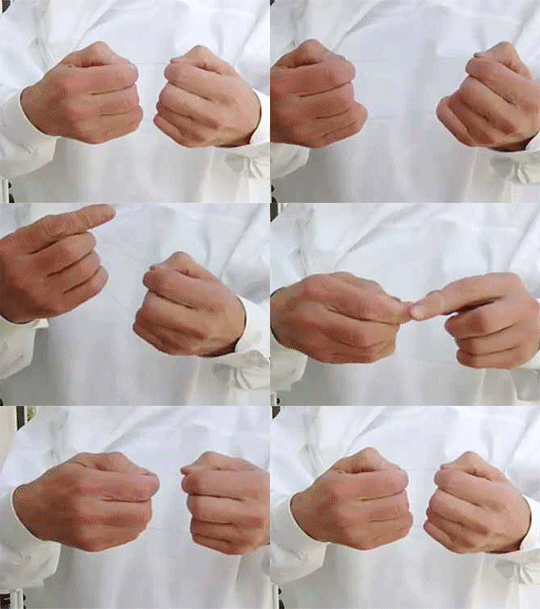
What an excuse for American ingenuity to strike – let’s make a floss out of those annoying rubber bands that are sewn into new clothes to keep them on the hanger in the store! By the way, here’s how to break those off of your T-shirts:

Notice how he’s wearing a white dress shirt backwards to make him look like a mental patient…err… dentist. And wrapping the floss professionally around HIS INDEX FINGERS. Every dental professional knows that the middle finger is the way to go. Flip the bird, double flip, point ’em high. That’s the way to break it. Otherwise you’re also suggesting that users should cut their circulation off when they floss. Next thing you know the inmates will be suing because they’ve got gangrene in their nailbeds.

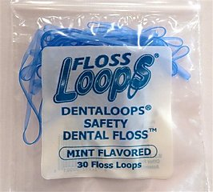
So anyways, here’s the Floss Loops website. The guy who owns the patent also sells inmate-safe soft toothbrushes so if you’re curious about those go take a look. At this posting all the brochures are 404-not-found, but at least you can get an idea of the toothbrush and floss you might have to use when you do finally go all “insane dentist” on the last patient that just really has it coming.


Filed Under: News, Preventive Care, Products Tagged With: dental care for inmates, Floss loops, prison dentistry

Patients: Floss Your $%#*^@# Teeth!

October 17, 2012 By Eva Watson 10 Comments

Now… don’t let the title of this piece make you cower into your stinky underpants drawer.

My intention is to simply explain the importance of why you lovely patients must floss your teeth.  After seven years of clinical experience and seeing the outcome of a non-flossing lifestyle, my hope is that those reading this highly important dental topic will gain the vital understanding of flossing and how gum disease will affect your life.

Let’s start by me asking for your full attention by you getting your crusty, Starbucks-stained teeth out of your $8.00 latte you really can’t afford but feel the urge to economically consume every, single morning before you go to your soon-to-be outsourced job that just increased your dental insurance premium for a minute because here’s what I have to tell you.

Are you ready?  Good.

If you don’t floss your gums will become a festering, disease-ridden, smorgasbord of unrelenting bacteria that will ultimately make your gingivae bleed in buckets every, single day of your life.  If you don’t floss your gums you will spend thousands (I’m not kidding) of dollars to simply control the incurable disease (and it is a disease) that you have let build up over years and years of utter neglect.

Exudate will ooze out from underneath your gums and after questioning by the clinical professional (How YOU doin’?) the finding(s) will be defined as ‘asymptomatic’.  That is, you will feel no pain.  What you will feel is the false sense of dental health with the perpetual lie you keep telling yourself when you think, “It doesn’t hurt,” while the blood-filled pus continues to bubble and percolate underneath your gums.

Allow me to continue.

Your social life will remain that of the lonely-lived bachelor/bachelorette whose breath completely, I mean, completely reeks so intensely, you will have no realistic chance of any dating prospects.  You will continue to waste money on the premium whitening kits at your local store to give off the illusion of a healthy mouth in the hopes of attracting a mate.  Your highly offensive, (Not  joking. It’s awful.) metallic-smelling breath from your lack of flossing is so oppressive no one will want to kiss you nor come within five feet of you.  (Yes.  The odor is that strong.)  And we can still smell it through the masks we wear.  Sorry.

Once your teeth become mobile, or loose, from the lack of flossing and the prolific bacteria eating away at your bone that supports your teeth, then, and only then, will you notice and mention the finding to your dentist and/or dental hygienist. (Hey, that’s me!)  You will hear the word ‘unsalvageable’.  You may even hear the word ‘hopeless’.  That means your loose tooth/teeth will have to be pulled out from your rotting mouth because you were lazy and didn’t floss.

You’ve just lost your tooth… which could have been prevented if you only had used that little piece of string.

Sleep tight.


Filed Under: Humor, Preventive Care Tagged With: dental humor, dental hygiene

The gum whisperer

October 13, 2012 By Trish Walraven 4 Comments

First things first: yes, this “whispering” phenomenon has invaded every niche of our well-being. It all started in a novel with just this one guy, he whispered to horses, then Cesar Millan got famous shushing dogs on TV. There are book whisperers, baby whisperers, ghost whisperers. OMG, there’s even a Bra Whisperer if you need someone to speak quietly with you or your wife’s upper anatomy.

So I just realized the other day that, I am, in fact, the gum whisperer.

Is it because I’m the world’s utmost authority on periodontal disease? Do I have such a kingdom of knowledge that it only makes sense to become an intellectual philanthropist to my patients and can cure them of every infirmity that sits just inside their lip line? Do my mad hand skills mean that I can strip only the glue off of a postage stamp with a Gracey 13/14 while it’s still stuck to an envelope behind my back as PROOF of my superior subgingival scaling abilities?

No.

I am the gum whisperer because… I actually whisper to people’s gums.

“Hang in there, interproximal gingiva! Give that #5 an extra squeeze for me today because that class II mobility is making my probe shake.”

When you’ve given up trying to convince the lifelong smoker that nicotine is his enemy, sometimes it’s just time to try a new approach. Maybe the person attached to those gums will think you’ve gone a little cray-cray, or maybe, just maybe, they might realize that you’ve started digging into your bag of desperation because they just don’t want to hear what you have to say. They’d like to give you their problem instead of dealing with it themselves.

Years ago, I took care of a patient that was into visualization, in a new-agey kind of way. She asked me to paint pictures and describe what healing needed to take place in her gums, so that she could create a pathway for sending her healing energy into the periodontium. I dunno, it was kind of soothing for me, too.

So occasionally I’ll speak softly to a patient as I’m nudging their gums, kind of like scratching a dog’s belly, “You like that, yes you do, yes you do!” Well, not that silly — definitely more clinical-minded because really, I don’t want people to start asking me to read their auras or anything like that.

Please let me know if you’ve found yourself talking to teeth, tongues, whatever body parts have engaged your healing linguistics, so that I don’t feel so all alone in this situation. And if I really am crazy, then it’s probably best not to let me in on the truth.


Filed Under: Anecdotes, Operative Dentistry, Preventive Care Tagged With: dental hygiene, gum whisperer, periodontal disease

One CT scan = 200 Panoramics

April 10, 2012 By Trish Walraven 5 Comments

No doubt you listened to the radio or television news today with a double take whut-What? There’s a Yale study that just came out which links the incidence of meningiomas to the frequency of dental radiographs taken during childhood? Your gentle ionizing beam of extrasensory perception is….BEING CRITICIZED?

Yes, yes it is. But have no fear, because the research, my friend, is also having its validity questioned. Supposedly there’s a significant likelihood of being diagnosed with a benign brain tumor if you grew up going to the dentist regularly and having periodic x-rays. This tumor, called a meningioma, is usually asymptomatic, and the vast majority of the time is discovered only when a person has a routine CT scan.

Okay, so is it just me who sees this flaw in the study? People who have CT scans just for “fun” are most likely to go to the dentist for “fun.” Only you should substitute the word “prevention” for “fun.” There were other people in the study who weren’t diagnosed with meningiomas. Was this because they didn’t have CT scans voluntarily (and their parents didn’t take them to the dentist very often, possibly)? And what is the criteria for needing a scan, since we’re criticizing the “need” for dental x-rays? I mean, CT zapping is not exactly radiation-free.

Go read these articles for yourself so that you’ll have well-formed opinions when patients ask about what they’ve heard in the media to help you turn around any radiation defiance that you may come up against in the next few weeks:

Dental X-Rays Linked to Common Brain Tumor, Study Finds – Huffington Post

Web MD: Annual X-rays May Expose Patients to Unnecessary Risk

Dental x-rays can double brain tumor risk – MSNBC.com

All about Meningiomas from Wikipedia

From ABC News: Early Dental X-Rays Linked to Brain Tumors

Now ask yourself who is healthier: the guy who never took a pill or saw a doctor his whole life, and felt great until the day he died? Or the one who did all the preventive stuff and discovered along the way that yes, he had some imperfections that needed to be treated?

See, it’s a stupid question that is irrelevant. Put it to bed, put this story to bed, go scare the masses with something fun. And yummy. And dangerous.

Like sugar.

For other reading, here’s a PDF of the ADA’s radiography recommendations, along with a previous DentalBuzz parody about radiation safety, and a comparison of dental radiation doses to other medical radiation doses.

Filed Under: News, Preventive Care Tagged With: Brain Tumors, CT scans, Dental X-Rays, Meningiomas, radiation safety

  • « Previous Page
  • 1
  • 2
  • 3
  • 4
  • 5
  • 6
  • Next Page »

About

DentalBuzz explores rising trends in dentistry with its own slant. The speed at which new products and ideas enter the dental field can often outpace our ability to understand just exactly the direction in which we are heading. But somehow, by being a little less serious about dentistry and dental care, we might get closer to making sense of it all.

So yeah, a tongue-in-cheek pun would fit really nicely here, but that would be in bad taste. Never mind, it just happened anyways. Stop reading sidebars already and click on some content instead.

Recent Posts

  • Dry Humor, Wet Biofilm: A DentalBuzz Look at Periodontal Desiccation Therapy
  • Are affordable online nightguards any good?
  • CareCredit: The Easy Way Billionaire Banks Fill Cavities in Their Profits
  • Off-Label and Totally Legal: What the FDA Won’t Say About Fluoride Varnish & SDF
  • Dentists Rejoice over the Leica Camera Tariffs
  • It’s not OK for your dental practice to use free cloud-based communication
  • Patients ask, “Is it safe to go back to the dentist?”
  • Free “return to work guide” from the American Dental Association
  • Why COVID-19 increases your need for contactless payments
  • A virtual care package from worried dental hygienists
  • Lead Aprons feel so good! Here’s why.
  • What is this $&!% on my toothbrush?

Article Archives

Contact Us

Guest columnists are welcome to submit edgy stories that cover new ground (no regurgitations, please!) , or if there's a topic that you'd like to see explored please punch in your best stuff here and see if it ends up sticking to the website.

Follow DentalBuzz on Social Media

  • Facebook
  • Instagram

DentalBuzz Copyright ©2008-2026 • bluenotesoftware.com • All Rights Reserved