• Archives
  • Products
  • Operative Dentistry
  • Dental Team Communication
  • Practice Management
  • News
  • Research
  • Dental Debates

DentalBuzz: a jolt of current

trends, innovations, and quirks of dentistry

  • Home – Latest Buzz
  • Bloglist
  • Indie Dental Showcase
  • Free Dental Timer
  • Practice printables
  • Podcasts

Dry Humor, Wet Biofilm: A DentalBuzz Look at Periodontal Desiccation Therapy

May 7, 2026 By Trish Walraven Leave a Comment

Sci Fi Hygienists destroying a biofilm creature

Every few years, dentistry finds a new way to fight periodontal disease, and every few years the dental community collectively narrow our eyes and says, “Okay, but does it actually work?”

Lately, desiccation therapy products like HybenX or PerioDT have been showing up in more periodontal conversations. Maybe a hygienist in your office came back from a seminar (thank you, Anne Guignon!) ready to dry out every periodontal pocket in sight. If you’re a patient, maybe you’re here because you want to learn more about “that new bacteria treatment thing” you saw online. Honestly, after dealing with enough stubborn 7-millimeter pockets, almost anything that sounds biologically plausible gets people’s attention these days.

Periodontal disease is perpetually frustrating. Deep pockets that can cause teeth to eventually fall out can improve beautifully in one patient and stubbornly linger in the next, despite thorough and frequent deep cleanings (scaling/root planing – SRP), excellent home care, and enough flossing guilt to power a small suburb. Dentistry has spent decades trying to find ways to improve outcomes beyond traditional SRP alone. We have tried local antibiotics, lasers, chlorhexidine chips, peroxide trays, antimicrobial rinses, photodynamic therapy, probiotics, and approximately seven bajillion products containing the words “biofilm disruption”. Now we are drying it out.

At first glance, desiccation therapy sounds slightly dramatic, like something involving tiny industrial fans under the gums, or terror-inducing like a classified bioweapon designed to remove every trace of moisture from human tissue. In reality, products like HybenX and PerioDT are chemical desiccants placed into periodontal pockets before or during SRP. Instead of functioning like antibiotics, they work by dehydrating and disrupting the biofilm matrix itself.

This is interesting, because biofilm is not just bacteria sitting politely on the tooth surface waiting to be removed easily with a daily brushing. It is an organized, sticky protective environment that allows pathogens to thrive while resisting both the body’s immune response and our increasingly creative attempts to evict them.

Desiccation therapy basically attempts to collapse the slime layer so instrumentation can work more effectively afterward. And that is probably why so many hygienists are paying attention. It feels mechanically logical. There’s less of “kill all the bacteria” and more focus on making the neighborhood unlivable.

That also separates it from many of the periodontal adjuncts we have relied on for the last twenty years. Arestin and other localized antibiotics attempt to suppress bacterial growth directly after SRP. Perio Protect approaches the problem from home, asking patients to wear peroxide trays daily over time. Lasers promise bacterial reduction with varying levels of scientific enthusiasm depending on who is presenting the lecture and how expensive the laser was.

Desiccation therapy lands somewhere in the middle. No expensive equipment. No prolonged antibiotic exposure. No hoping patients suddenly develop Olympic-level compliance with home care routines. And that last part matters more than we like to admit.

Perio Protect can work very well for motivated patients, but every hygienist reading this has heard patients swear they’re cleaning their teeth well while staring directly at enough interproximal bleeding to suggest otherwise. Compliance has always been the weak spot in periodontal therapy. The most exquisitely engineered home-care system in the world still depends on a human being deciding to use it consistently after dinner when they are tired and watching Netflix. Desiccation therapy removes that uncertainty. The treatment happens chairside, under clinician control, during the appointment itself.

That does not mean that desiccation therapy is magic.

The research so far is promising, but not definitive. Studies have shown improvements in bleeding reduction and pocket depth when desiccation therapy is used alongside SRP, particularly in deeper or inflamed sites. At the same time, the evidence base is still fairly young. Long-term data is limited, protocols vary, and we are nowhere near the point of calling this standard therapy for every periodontal patient walking through the door. Which is probably exactly where reasonable clinicians should land right now: we should be interested, but not hypnotized.

Desiccant in gingiva

There is also the small matter that these products are not nearly as gentle as some marketing language might imply. The SDS sheets for HybenX and similar products contain repeated warnings about corrosive effects, tissue irritation, and careful handling due to their sulfuric acid and sulfonated phenolic chemistry. This is not simply another tooth gel. Used appropriately, desiccation therapy appears safe and effective as an adjunctive treatment. Used carelessly, it is still a highly acidic chemical agent being placed into inflamed tissue.

That nuance is important because dentistry sometimes struggles to occupy the middle ground between cynicism and infomercial. Every new periodontal adjunct gets treated either like a revolution or a scam, when the reality is usually much less exciting and far more useful.

Most periodontal therapies help a little. Some help certain patients a lot. None exempt us from the fundamentals. Good instrumentation still matters. Maintenance still matters. Smoking, diabetes, xerostomia, stress, medications, and home care still matter. Biofilm remains deeply unimpressed by marketing campaigns and dramatic product names.

Still, desiccation therapy may end up carving out a meaningful place in periodontal care because it approaches the problem differently. Not by adding another antibiotic to the mix, but by disrupting the physical environment that allows pathogenic biofilm to organize itself in the first place.

And honestly, after decades of trying to chemically negotiate with bacteria, there is something deeply satisfying about simply drying out the sleazy slime condo and telling the whole microbial neighborhood to move out.

Congratulations to the bacteria on losing their security deposit.

_____________________________________

Trish Walraven, RDH, BSDH is a dental hygienist, writer, and curious observer of the strange relationship between science, marketing, and what actually happens in periodontal pockets.

____________________________________

Resources

Isola G, Matarese G, Williams RC, et al.
The effects of a desiccant agent in the treatment of chronic periodontitis: a randomized, controlled clinical trial. Clinical Oral Investigations. 2018;22(2):791-800.

One of the better-known studies evaluating desiccation therapy alongside scaling and root planing, showing improvements in clinical and inflammatory outcomes.
https://info.youngspecialties.com/periodt-clinical-study-isola

American Dental Association
Evidence-Based Clinical Practice Guideline on the Nonsurgical Treatment of Chronic Periodontitis by Scaling and Root Planing with or without Adjuncts.
A helpful overview of where adjunctive therapies fit into periodontal care and why SRP remains the foundation of treatment.
https://www.ada.org/resources/research/science/evidence-based-dental-research/nonsurgical-treatment-of-periodontitis-guideline

Vyas T, Bhatt T, Kumar V, et al.
A Local Desiccant Antimicrobial Agent as an Alternative to Adjunctive Antimicrobials in Periodontal Therapy.
A review discussing desiccation therapy, biofilm disruption, and the broader shift away from relying exclusively on antibiotic-based periodontal adjuncts.
https://pmc.ncbi.nlm.nih.gov/articles/PMC10044681/

________

Have you tried desiccation therapy in your practice, or had it recommended as a patient? We would genuinely love to hear what you are seeing in real-world periodontal treatment, so jump into the comments below.
Filed Under: Dental Debates, Featured, Operative Dentistry, Products, Research Tagged With: Biofilm, dental hygiene, Dental Technology, Desiccation Therapy, Gum Disease, HybenX, Non-Surgical Periodontal Therapy, Oral-Systemic Health, Perio Protect, periodontal disease, periodontics, preventive dentistry, Scaling and Root Planing, SRP

Is Arestin® a red flag?

September 5, 2014 By Trish Walraven 70 Comments

placementflags
Not long ago, all dental practices were owned by the dentist who took care of you. Sure, they might not have given you any anesthetic before they smashed silver crunchy metal into your cavities, and they may have slapped you around and given you Post Traumatic Stress Disorder any time you thought about opening your mouth wide for anyone, but at least you knew that the dentist shoving their knuckles into your nostrils was the one dictating how things were done around there.

Since then, dentistry has gone all Wal-Mart on the public. There are thousands of dental offices that are part of large chains, where the dentists who take care of you are merely employees, where the quality of dental care provided to patients is secondary and instead the amount of profit generated by each provider becomes the indication of that person’s worth within the company. Can you imagine a leaderboard, like in a sales department, where all the dentists’ production numbers are on display for the entire office, so it’s a race to see who can make the most money?

LeaderboardDental

As a patient, don’t you get giddy at the thought of being ridden like a thoroughbred horse? Me neither. My health is not a commodity.

Dentistry is a little different creature than regular medicine in the sense that TEETH ARE OPTIONAL. You can be a very healthy individual, only with no teeth. It’s kind of like having a hand amputated – your quality of life may be affected, but a hopelessly infected hand should be removed and replaced with a prosthetic. If your body is rejecting your teeth for whatever reason, that’s when there are health concerns as well. Dental professionals make it their life’s work to help you keep your teeth in as close to original condition as possible.

The problem is that when money is involved, you can bet that there are those who will abuse this relationship. There’s scare tactics, there’s bait-and-switch, there’s all the usual sleazy sales pressure used to extract as much income from each patient as possible. New patients often bring us treatment plans that they are unsure of, looking for second opinions, trying to figure out why they don’t trust the previous dental offices’ diagnoses. I just want to say it straight, “They’re taking you for a ride, dear.”

Whip. Whip.

Well crud, I never wanted this article to be an analogy of horse racing with the big hats and Bourbon and milk-drinking and jockeys. So, let’s start over and begin talking instead about Red Flags and Grey Areas.

redflag

Red flags, of course, are the signals you get when you realize something that seems good, isn’t so good. Red flags are big fat warning signs.


Greyarea
 

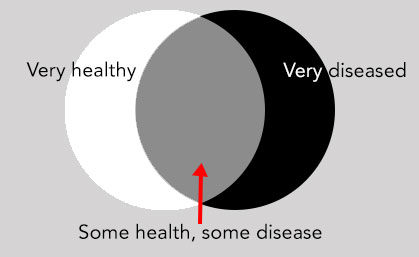
Grey areas, are, well, not really black and not really white.  Grey areas are where black and white kind of blur into each other, and sometimes they end up looking a little suggestive (!) like the image above. Yeah, sorry about how weird that looks when I take it out of context.

When it comes to the health of your mouth we usually look at two things: your teeth, and the stuff that holds your teeth in your mouth. That’s what we’re going to talk about in this discussion, what you think of as your gums. Dental professionals call this part of you your periodontium. If your gums are in excellent condition, you have what is called periodontal health. On the other hand, if your gums are seriously letting go of your teeth you have periodontal disease.


As you can see, the biggest part of this diagram is the Grey Area. This is where most people land, especially if they haven’t been to the dentist in a while. Even if your front teeth are mostly healthy often you’re automatically categorized into the Very Diseased category because you have too many spots in your mouth that are infected with bacteria to treat you as a Very Healthy person. That’s when you’ll get a treatment plan designed to minimize the effects of your disease.

When your mouth is in the Grey Area, this is where treatment recommendations can vary the most from office to office and even from person to person. Almost every dentist will prescribe the same treatment course if your case is black and white (very diseased or very healthy). If you’re in the Grey Area though, this is when Red Flags will start to stick out.

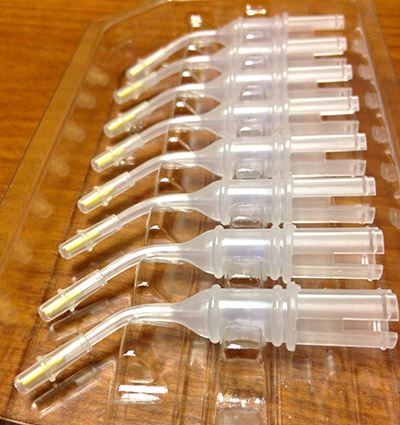
There’s one Red Flag in particular that keeps showing up. Arestin® is a yellow powder containing minocycline microspheres – an antibiotic designed to help diseased gums heal faster. The powder is puffed deep into an infected spot under the gumline where it hardens upon contact with moisture and time-releases the antibiotic for about three weeks. Here’s what the package of cartridges looks like, with the yellow powder in the tip:

cartridges


Arestin is a great product! I’ve seen stubborn gum disease completely disappear when we’ve used it very selectively in our practice. So the Arestin itself isn’t a problem. The problem is how it’s being prescribed.

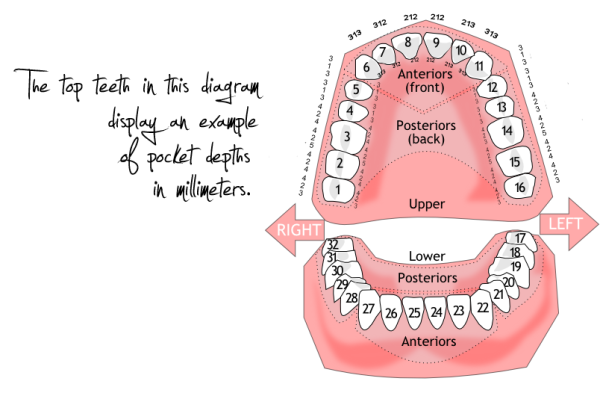
Say you had your gum disease treated with scaling and root planing (a “Deep Cleaning”), but a few spots are still unhealthy a month or two or three later. If your dentist or hygienist sees that you still have open sores that are higher than a certain parameter (over 4mm is considered the standard) this is when Arestin therapy provides the most benefit.probingexample

So when is Arestin a Red Flag? You’ve visited a new dental office, and not only are they recommending that you have treatment for your periodontal disease, they’re also saying you need a course of Arestin to be placed on the same day that you have your initial treatment. It’s even a bigger red flag if you floss regularly and never see your gums bleed.

The thing is, Arestin isn’t cheap. Just a single cartridge costs your dentist upwards of $15. Then there is the insertion fee; in other words, what the patient is billed for placement, and than can run as much as $60 per site.

Here’s where it gets crazy. An average mouth has 28 teeth. Each of your teeth has as many as six sites where Arestin can be placed. Let’s see, that’s $90 in material costs, $360 in placement costs. That’s potentially going to cost you $450 – per tooth.

You’re seeing the big picture now: treating gum disease can be quite profitable! This is why Arestin is such a big deal in the offices that are part of corporate dental chains designed for maximum shareholder profit. This antibiotic is marketed to dental professionals as a way to help us make money, all in the name of “helping our patients.”

So how do you end up getting prescribed Arestin therapy if your mouth is pretty healthy? If your hygienist or dentist was instructed to “force the probe” to create a deep measurement, that’s how. Stab ’em hard and voila! Fake gum disease! Here’s a story that exposes some of the bad things that have allegedly happened in corporate dentistry, including this example:

http://www.pbs.org/dentalworks-chain-misdiagnosed-for-money-dentists-say/

As you can see, lots of other stuff can be exaggerated as well to make sure that the dentistry performed on you is as profitable as possible. For now, though, we’ll stick to talking about the Red Flag, because this one cue may help you decide whether or not you’re being over treated.

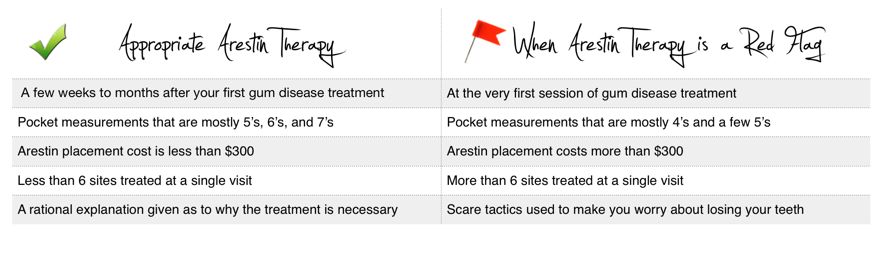
Here are the professionally accepted general guidelines about Arestin usage, then:

Appropriate therapy gridNow please don’t use this to go and bash your well-meaning dentist and hygienist, or the Arestin company, or worst of all, to justify the reasons you tell yourself why you don’t go to the dentist ’cause it’s all one big scam and you can’t trust anyone. Most of us really do want the best for you.

The point is simply this: if more people understand the difference between dental care that is patient-centered and dental care that is profit-centered, then greedy dental corporations are less likely to thrive.

If you think you have ever had this happen to you, I wrote this story for you. For you, so that you don’t feel so dumbfounded the next time you wonder whether or not a dental office is looking out for your health or only for their own. As a hygienist who knows fraud when I see it, I wanted to be sure that patients have a resource to help them defend themselves against predatory practices.

I’d like to end this with a small confession, then: I actually love placing Arestin, because when the dentist and I decide that it’s a good fit for a stubborn case of gum disease, it just feels so right.

So much for being objective.


References and resources:

Explanation of insurance coding of Arestin therapy after initial SRP: http://www.practicebooster.com

An example of Arestin-based fraud in a DHMO: http://caldentalplans.org/downloads/Henderson.pdf

Arestin drug label and study that shows slight improvement of using Arestin with SRP vs. SRP alone: http://dailymed.nlm.nih.gov/arestin

Criticism of Arestin studies and concerns about Arestin therapy : http://periodontist.org/is-arestin-a-therapeutic-treatment-for-reducing-gum-pockets/

A blogger since 1997, Trish Walraven, RDH, BSDH is a practicing dental hygienist and marketing manager for an indie dental software development company. Her mission with DentalBuzz is to offer a fresh podium of discourse for those involved in dentistry and to expose fun in our professional lives.

Filed Under: Anecdotes, Dental Debates, Featured, Money, Operative Dentistry Tagged With: antibiotic use in dentistry, Arestin, corporate dentistry, dental fraud, minocycline, periodontal disease

The gum whisperer

October 13, 2012 By Trish Walraven 4 Comments

First things first: yes, this “whispering” phenomenon has invaded every niche of our well-being. It all started in a novel with just this one guy, he whispered to horses, then Cesar Millan got famous shushing dogs on TV. There are book whisperers, baby whisperers, ghost whisperers. OMG, there’s even a Bra Whisperer if you need someone to speak quietly with you or your wife’s upper anatomy.

So I just realized the other day that, I am, in fact, the gum whisperer.

Is it because I’m the world’s utmost authority on periodontal disease? Do I have such a kingdom of knowledge that it only makes sense to become an intellectual philanthropist to my patients and can cure them of every infirmity that sits just inside their lip line? Do my mad hand skills mean that I can strip only the glue off of a postage stamp with a Gracey 13/14 while it’s still stuck to an envelope behind my back as PROOF of my superior subgingival scaling abilities?

No.

I am the gum whisperer because… I actually whisper to people’s gums.

“Hang in there, interproximal gingiva! Give that #5 an extra squeeze for me today because that class II mobility is making my probe shake.”

When you’ve given up trying to convince the lifelong smoker that nicotine is his enemy, sometimes it’s just time to try a new approach. Maybe the person attached to those gums will think you’ve gone a little cray-cray, or maybe, just maybe, they might realize that you’ve started digging into your bag of desperation because they just don’t want to hear what you have to say. They’d like to give you their problem instead of dealing with it themselves.

Years ago, I took care of a patient that was into visualization, in a new-agey kind of way. She asked me to paint pictures and describe what healing needed to take place in her gums, so that she could create a pathway for sending her healing energy into the periodontium. I dunno, it was kind of soothing for me, too.

So occasionally I’ll speak softly to a patient as I’m nudging their gums, kind of like scratching a dog’s belly, “You like that, yes you do, yes you do!” Well, not that silly — definitely more clinical-minded because really, I don’t want people to start asking me to read their auras or anything like that.

Please let me know if you’ve found yourself talking to teeth, tongues, whatever body parts have engaged your healing linguistics, so that I don’t feel so all alone in this situation. And if I really am crazy, then it’s probably best not to let me in on the truth.


Filed Under: Anecdotes, Operative Dentistry, Preventive Care Tagged With: dental hygiene, gum whisperer, periodontal disease

About

DentalBuzz explores rising trends in dentistry with its own slant. The speed at which new products and ideas enter the dental field can often outpace our ability to understand just exactly the direction in which we are heading. But somehow, by being a little less serious about dentistry and dental care, we might get closer to making sense of it all.

So yeah, a tongue-in-cheek pun would fit really nicely here, but that would be in bad taste. Never mind, it just happened anyways. Stop reading sidebars already and click on some content instead.

Recent Posts

  • Dry Humor, Wet Biofilm: A DentalBuzz Look at Periodontal Desiccation Therapy
  • Are affordable online nightguards any good?
  • CareCredit: The Easy Way Billionaire Banks Fill Cavities in Their Profits
  • Off-Label and Totally Legal: What the FDA Won’t Say About Fluoride Varnish & SDF
  • Dentists Rejoice over the Leica Camera Tariffs
  • It’s not OK for your dental practice to use free cloud-based communication
  • Patients ask, “Is it safe to go back to the dentist?”
  • Free “return to work guide” from the American Dental Association
  • Why COVID-19 increases your need for contactless payments
  • A virtual care package from worried dental hygienists
  • Lead Aprons feel so good! Here’s why.
  • What is this $&!% on my toothbrush?

Article Archives

Contact Us

Guest columnists are welcome to submit edgy stories that cover new ground (no regurgitations, please!) , or if there's a topic that you'd like to see explored please punch in your best stuff here and see if it ends up sticking to the website.

Follow DentalBuzz on Social Media

  • Facebook
  • Instagram

DentalBuzz Copyright ©2008-2026 • bluenotesoftware.com • All Rights Reserved