• Archives
  • Products
  • Operative Dentistry
  • Dental Team Communication
  • Practice Management
  • News
  • Research
  • Dental Debates

DentalBuzz: a jolt of current

trends, innovations, and quirks of dentistry

  • Home – Latest Buzz
  • Bloglist
  • Indie Dental Showcase
  • Free Dental Timer
  • Practice printables
  • Podcasts

Open, sesame!

March 5, 2012 By Trish Walraven 3 Comments

I wish they would have named it “Strangle Me Elmo.” Because that’s how I feel about that particular character.

Sesame Street was my babysitter growing up, especially since the show and I are practically the same age. So when the news comes that Sesame Workshop is launching an educational oral health initiative geared towards two year olds and up, I get it. They’re about modeling good habits with jingles and images that kids will remember when it’s their time to “do what they saw on TV.”
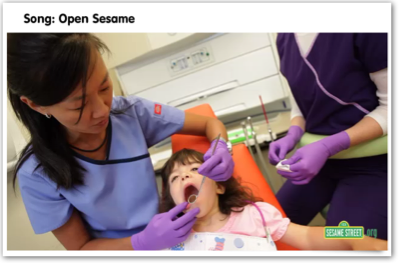
This is especially helpful for the kids from low-income families, because parents may not realize that their own belief systems about primary teeth can prevent children from getting appropriate care. When a kid sees Elmo brushing his teeth and eating healthy “crunch” foods, studies show that they’re very likely to have positive changes in their own nutrition and hygiene habits, and so even if they’re not going to the dentist, they just might have healthier teeth.

Elmo’s annoying voice was not part of my childhood, so I don’t “connect” with him. But I would, oh, I SO would connect with him, if someone wanted to put him in my hygiene chair and let me spin a prophy cup at his fur.


Learn more about Sesame Workshop and their “Healthy Mouth, Healthy Me” series here, and you also may enjoy reading this interview with Dr. James Crall, Sesame Workshop advisor and professor of pediatric dentistry and public health & community dentistry at UCLA.
Filed Under: Preventive Care, Research Tagged With: Early childhood prevention, Healthy Me, Healthy Teeth, Sesame Street, Sesame Workshop

Share this with patients

December 28, 2011 By Trish Walraven Leave a Comment

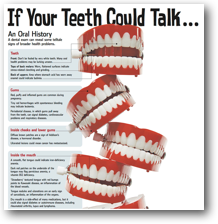
The general public has no excuse when the Wall Street Journal has succinctly and comprehensively explained why dentistry is so important to patients’ overall health. Make copies, post a link from your Facebook page, tweet about it. Just make sure that EVERYONE IN YOUR NEIGHBORHOOD reads this article, watches the video, or interacts with the snapshot graphics. Click on the title below to visit:

If Your Teeth Could Talk…

The Mouth Offers Clues to Disorders and Disease; Dentists Could Play Larger Role in Patient Care


Way to go, WSJ.

Filed Under: News, Preventive Care

If dental care is free, then who cares?

October 4, 2011 By Trish Walraven 1 Comment

The results of a national survey conducted a few months ago were released today:

Majority of Americans Support Mid-Level Dental Provider to Expand Access to Dental Care

Four-in-Ten Americans or Their Family Members Put Off Dental Care Due to Cost, according to the W.K. Kellogg Foundation.

BATTLE CREEK, Mich. – Millions of Americans cannot find affordable dental care in their communities and many want to explore mid-level providers as a way to improve their access to needed oral health care, according to a national survey released today by the W.K. Kellogg Foundation.

The survey reveals that many Americans are struggling to get the care that they need. Forty-one percent of Americans report they or someone in their household has put off dental care because of cost and 30% say they do not have a place to receive dental care.

Based on a poll of 1,023 adults, the survey, conducted by Lake Research Partners, finds that more than 80% of Americans believe it is difficult for people to get free or low-cost dental care in their communities, and think the number of Americans who cannot access dental care is a problem.

>> Read more of this original story at WK Kellogg Foundation News.


Here’s my thoughts on this survey: We are born with teeth, we don’t have to purchase them, so why should we have to keep paying for them? This mentality is what leads people to get away with the least cost for medical care as possible, because they don’t want to have to pay for something that they originally got for free. “Every tooth in a man’s head is more valuable than a diamond.” – Miguel de Cervantes, Don Quixote, 1605

So duh, of course the survey would reflect such an attitude. Whether it’s economically feasible to create a midlevel provider position or not shouldn’t even be in question; the current markets of dentists and hygienists are already flooded in metropolitan areas. The solutions should be incentive-based: forgiveness of school loans, possibly more independent preventive care delegation to hygienists in public health settings, much more education-based intervention, aggressive messages from AdCouncil or whatever it takes to get the word out that natural teeth are an investment; at the going rate a full set of implants is what? 50 grand? THERE’S your message.

Originally I posted this statement at Dr. Bicuspid but thought it could stand an airing-out here as well. And I know, as a card-waving member of the American Dental Hygienists’ Association you’d think I’d be all for the creation of a midlevel provider position, right? I probably would be, except for one thing: the current anticipated incomes of midlevel providers are significantly less than the average hygienist incomes in this country. It’s almost like there was a deal in the back corner of a committee, saying: hahaha, you GO to school two more years, girlie-girl. The dental boards will assure that it’s not economically worth your while to further your education.

Until the in-fighting between the militant factions of dentists and hygienists simmers, I believe that this survey only serves to get under the skin of those who will use it to justify their own stances. Something’s got to change though, when doctors and patients alike are excessively frustrated with some questionable treatments that are performed in dental clinics primarily funded with Medicaid dollars.

Here’s how I know something’s wrong with our government dental care programs: the majority of today’s Medicaid offices aren’t even hiring hygienists. So much for midlevel providers. So much for prevention.


Filed Under: News, Preventive Care Tagged With: Kellogg Foundation, Midlevel providers

Jamming on the Sonicare AirFloss

May 5, 2011 By Trish Walraven 6 Comments

by Trish Walraven

I’m taking flossing to the airwaves. Mah NUMPH bErrr BEHRRRRR… Don’t my riffs sound great?

No?

But it’s air guitar, man, use your imagination! Feel the energy, the passion, the creative flow that turns all of us into rock stars on our gaming consoles!

Something you may not have realized is that you are already a star, at least in the eyes of your patients. A Dental Star. Rock on. Your opinions are gold. Patients ask which toothpaste is best? Which mouthwash should they be using?

One question they never ask is “What should I use to clean between my teeth?” Do patients even register a thought about their interproximal surfaces? Here’s a question for you as a person, not as a dental professional: how often do you think about the skin between your toes? (toejam. eww.)

My point exactly.

But we think about the skin between teeth all the time. That’s where we see the most gingivitis, the highest plaque scores, the most room for improvement. And we’re tired of laying guilt trips on our patients when we realize that they’re not flossing.

That’s when you want to be able to point to alternatives and say to your non-flossers, “Maybe this will work for you.”

Water Piks are wet, messy, and have been around since the 1960’s. Still, they are my go-to recommendation for non-mechanical biofilm reduction because I see improvements in bleeding scores with patients who use them daily. They are also ubiquitous and affordable, making them more attractive than some of the higher priced or obscure dental water jets.

What’s that? Philips has a new gadget that competes with Water Pik? Well, Philips products can be bought everywhere, too! Can you say, “market penetration?” Can you say, “a funhouse explosion in your mouth?”

It’s called the Sonicare AirFloss, and it was introduced to the world a few weeks ago at the International Dental Show in Germany. Philips is being cheeky about it at the moment, but it looks to be making its American debut at the California Dental Association Meeting in Anaheim next week.

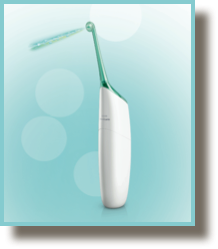
The Sonicare AirFloss is said to replace flossing with micro-bursts of water and air. Fill its reservoir with a few teaspoons of mouthwash or water and you’re ready to blast the little legs off your biofilm bugs.

As of this writing, the only way to learn more about the AirFloss is to sign your office up for a Lunch and Learn at the Sonicare website. Who would turn down free food and a nugget of sponsored CE credit to expand their knowledge base about a product that patients will soon be coming to us for answers about its worthiness?

I am always intrigued by the buzz about new preventive products. As an idea that Philips recently acquired with the purchase of Discus Dental, the Air Floss is being presented in a warm fuzzy cushion of patient acceptance. Do patients like this more than flossing? Do they like it more than using a Water Pik? This presentation makes me think that the science behind the product hasn’t shown the health results that Philips had hoped it would. Watch this video from the IDS in Cologne and see what you think. This is Maria Perno Goldie, RDH Village eFocus editor:


And then there’s me. My family will be so thankful when we get an AirFloss because it might just keep me from pretending to be on American Idol when I think I’m alone in the bathroom:


Concert yell, WooOOOOOOOO!

Living the dream, baby.


Thanks, Star Dental, for the shirt. You rock, too.


5/13/11 Update: The AirFloss is now live on the Sonicare Website!

Filed Under: Preventive Care, Products Tagged With: advertising, AirFloss, linkedin, new products, Philips, preventive care, Sonicare, Water Pik

Release the (S.) mutants

February 9, 2011 By Trish Walraven 2 Comments

by Trish Walraven

The Dramatization:

At first it was small. The outbreak began in Florida’s Tampa Bay Area as local hospitals noticed an influx of patients with complaints of turquoise discolorations of their lips and aversion to simple carbohydrates. Once case histories were correlated it was noticed that all those who were affected had either recently received an inoculation of a mutant version of Streptococcus mutans at their dentist’s office or had been in close contact with someone who had.

Initially the culprit was thought to be excessive consumption of blue raspberry slushies, but by the time the CDC discovered that an organism was responsible for these symptoms and that it was bacterial in origin and highly contagious the disease had spread far beyond Florida and had affected millions throughout the US and abroad.
There have been no reports of mortality, save the demise of the soft drink and candy industries. Sugar consumption has plummeted as more of the population becomes infected by this new strain of bacteria which was originally created to cure the problem of dental decay. Because persons who are affected display a noticeable change in their appearance, blue lips have become a strong signal of exclusion due to the fear surrounding this epidemic. However, as more evidence points to the positive outcomes of having been infected, the “blue look” is currently trendy in the larger cities. Blue-lipped patrons that had been banned from public venues such as restaurants and arena events are slowly trickling in, thanks to the assurances from the World Health Organization that this current situation has actually caused more good than harm. The long-term effects will be felt by dentists, who, in the next 30 years, will see an attrition of their necessity as caries becomes extinct, and possibly within the cosmetics industry with a shift in lip color preferences.

The Reality

Um, Yay? It’s been like, since the early 70’s that everyone’s been asking for a caries vaccine. And wouldn’t you know it? A company in the United States is already so ON this. Oragenics first initiated their first Phase 1 Clinical trials in 2005 but were halted by the FDA because of the fear of something happening like the above scenario. Think I’m kidding? Okay, maybe I was being sensational. But there can be genuine risks when you fiddle with a few genes, and the FDA seemed to be mainly concerned with the lack of a plan to eradicate attenuated strains in the test subjects’ children. AHHHHH!

It starts to get interesting when you look at the solution that Oragenics came up with to begin their second Phase 1 testing announced last week: The trial subjects will be inoculated with a strain of S. mutans that cannot survive without the amino acid D-alanine, which is not found in a normal human diet. This means that the subjects will have to feed their germs daily with a mouthwash to keep them from dying.

Are you excited yet? Well, you’d better hold those horses back for a while. A long while. It’s going to take a bunch of time and a lot more money to get this to the market.

The inoculation is designed to be a painless 5-minute treatment with a cotton-tipped swab to deliver the suspension of Oragenics’ patented bacterial strain into a patient’s mouth during routine dental visits. But this one won’t die without feeding. It will live forever.

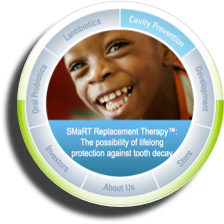
And what is it supposed to do once it goes viral? Err… bacterial? Oragenics calls this treatment SMaRT Replacement Therapy™ and it promises to:

• Offer lifelong protection against tooth decay caused by S. mutans

• Eliminate the creation of lactic acid by oral bacteria

• Dramatically reduce the ability of S. mutans to cause tooth decay

• Be genetically stable

• Grow at a rate similar to non-genetically-altered S. mutans

• Aggressively displace the native, decay-causing strains of S. mutans and preemptive colonization of its niche

• Not cause any acute or chronic adverse side effects

I think it’s a foregone conclusion that this sort of genetic manipulation is probably the only way we’ll and break caries’ hold on humanity and the loss of teeth caused by decay. We can’t just kill all the bugs in our gut – all the Jamie Lee Curtis Activia commercials have given us TMI about probiotics lately – so it makes sense that this same premise is true in our mouths.

And the raspberry slushie is still your best bet for getting blue lips. Sorry, Oragenics will probably not be helping you there.


Filed Under: Preventive Care, Products, Research Tagged With: caries vaccine, FDA, linkedin, mutant bacteria, Oragenics, research, Strep mutans

  • « Previous Page
  • 1
  • 2
  • 3
  • 4
  • 5
  • 6
  • Next Page »

About

DentalBuzz explores rising trends in dentistry with its own slant. The speed at which new products and ideas enter the dental field can often outpace our ability to understand just exactly the direction in which we are heading. But somehow, by being a little less serious about dentistry and dental care, we might get closer to making sense of it all.

So yeah, a tongue-in-cheek pun would fit really nicely here, but that would be in bad taste. Never mind, it just happened anyways. Stop reading sidebars already and click on some content instead.

Recent Posts

  • Dry Humor, Wet Biofilm: A DentalBuzz Look at Periodontal Desiccation Therapy
  • Are affordable online nightguards any good?
  • CareCredit: The Easy Way Billionaire Banks Fill Cavities in Their Profits
  • Off-Label and Totally Legal: What the FDA Won’t Say About Fluoride Varnish & SDF
  • Dentists Rejoice over the Leica Camera Tariffs
  • It’s not OK for your dental practice to use free cloud-based communication
  • Patients ask, “Is it safe to go back to the dentist?”
  • Free “return to work guide” from the American Dental Association
  • Why COVID-19 increases your need for contactless payments
  • A virtual care package from worried dental hygienists
  • Lead Aprons feel so good! Here’s why.
  • What is this $&!% on my toothbrush?

Article Archives

Contact Us

Guest columnists are welcome to submit edgy stories that cover new ground (no regurgitations, please!) , or if there's a topic that you'd like to see explored please punch in your best stuff here and see if it ends up sticking to the website.

Follow DentalBuzz on Social Media

  • Facebook
  • Instagram

DentalBuzz Copyright ©2008-2026 • bluenotesoftware.com • All Rights Reserved