• Archives
  • Products
  • Operative Dentistry
  • Dental Team Communication
  • Practice Management
  • News
  • Research
  • Dental Debates

DentalBuzz: a jolt of current

trends, innovations, and quirks of dentistry

  • Home – Latest Buzz
  • Bloglist
  • Indie Dental Showcase
  • Free Dental Timer
  • Practice printables
  • Podcasts

Dental Obamacare

January 20, 2009 By Trish Walraven 6 Comments

We were impressed that when put on the spot between inaugural balls today, President Barack Obama was able to outline his plan to give all people in the United States of America the right to a beautiful, healthy smile. The big question is: just who are his dental advisors?

Obama’s Mastication Initiative for America (MIA)

The people of the United States should realize that teeth are a quality of life issue. The government cannot force a citizen to take care of his or her body, nor should a person be penalized for issues that are beyond their control. We have seen the insurance industry take hold of healthcare and overvalue its services. Furthermore, dentists throughout our great nation have resisted the tide of managed medicine and are now capable of not only improving the quality of their patients’ lives, but even the very length of the average American lifespan.

When we look at the technological advances that have been made in dentistry, we know that now is the time for change. It is this administration’s hope that by combining personal responsibility with expert guidance, my Mastication Initiative for America will fulfill the needs of all Americans, not just the ones barely getting by; not just the wealthy, but every one of us.

The details will be forthcoming when I have more than a few breaths of air between dipping my wife on dance floors, but here is a brief outline of the plan:

1. Participation in the plan is voluntary, both for dental providers and for patients.

2. Payments will be made directly to patients on a yearly basis, with the exception of the Lump Sum plan that is described in line 6.

3. All participating dental practices will engage the use of a government-approved method of data gathering and reporting, to be agreed upon in the future, but possibly a special watermarked panoramic digital image that can be submitted to the Department of Health and Human Resources. This will significantly decrease the ability for fraudulent reporting on patient status.

4. Each person under the age of 30 will be required to have yearly dental images submitted on their behalf for reimbursement by the federal government. There will be a fixed amount allowed per person, regardless of actual care rendered. i.e. $500 per year per person under 30. Under no circumstances will any funds be reimbursed if basic preventive measures were not pursued by the patient or their family.

5. Third Molar Extraction will be considered a medical expense, as will any congenital deformity that is currently considered the arena of oral maxillofacial surgeons, so is excluded from the MIA plan.

6. At the age of 30, regardless of previous dental history, all citizens will be eligible for Dental Implant Screening (DIS). Because of the excellent properties of implants versus natural teeth regarding the elimination of the periodontium and thus the link to systemic disease, it is the MIA’s recommendation for DIS to be implemented before dental disease is likely to permanently affect a person’s whole health. Those who are at risk for losing their teeth, who have already lost teeth, or who simply make the choice of not wanting to maintain their teeth will, at this time in their lives, be given the opportunity to have all their teeth removed and have dental implants placed instead. This is a Lump Sum, and will include a preventive appliance to be worn at night. Any person who has implants with DIS will not be able to participate in the MIA after having implants placed.

7. DIS practitioners will work directly for the government, be well-trained, and well-compensated for their expertise.

8. From the age of 30 onward, payments from the MIA will be based on the number of healthy, maintained teeth that a patient displays in the accepted yearly imaging submitted. Included as healthy teeth: those with no restorations, restored teeth with no active defects, teeth with successful root canal therapy, periodontally involved teeth with no bone loss noted within the past year, and dental implants. Teeth that would not be counted for MIA payments: Broken teeth, retained root tips, teeth with active decay, and teeth showing periodontal involvement that has progressed since the previous submitted image.

This is the plan that will ensure that all Americans will be able to smile proudly, whether it is a God-given smile or one granted to them by choice, and no longer will we as a nation be faced with lost work time, emergency room visits, and other troubles caused by bad teeth. After all, this is the very soil where the “Hollywood Smile” was born, and so I ask you to consider what is best for our country, for our children, and for dentistry in the new economy to come.

Filed Under: Dental Debates, Fun, Money, Operative Dentistry, Preventive Care Tagged With: dental implants, dental insurance, healthcare reform, Obama, obamacare, Obamanomics

Freeze Teeth for the Future

December 16, 2008 By Trish Walraven 2 Comments


Dear Santa,

This is so hard; I didn’t know who else I could write that could help me in my dilemma. My college finals are over and I recently went to oral surgeon’s office about my wisdom teeth. The plan is to have them taken out right after Christmas. The deal is, they’re not hurting. In fact, they are so buried in the bone that they aren’t even close to my other molars.


The weird thing was when I went to the oral surgeon for a consultation, he told me that when he took the wisdom teeth out, he could send all of them to a cryogenics lab where they would extract my stem cells and freeze them in case I needed them in the future to grow new nerve, cartilage, bone, a liver, or even a new heart.


I thought about it a lot, I really did, Santa. Did my research, too and realized that you’ve got some experience dealing with people who want to deep freeze everything they can touch. Here’s what I came up with:

  • The company that my dentist is using is called StemSave. It costs about $700 for StemSave to process and store my wisdom teeth for the first year and $100 per year afterwards. Until I use them or die, whichever comes first. 
  •  BioEden is another company that also cryopreserves teeth for future use, with methods and fees similar to StemSave’s.
  • The technology for the actual preservation seems good, and wisdom teeth may have more useable adult stem cells compared to bone marrow if I get sick and need them later in life.
  • As teeth age, they have fewer stem cells in them.
  • There is a bit of controversy on the subject – I’m worried that stem cell banking may be more beneficial for the cryobanking investors than for the patients. There’s not really enough long-term data to suggest anything but hope on the researcher’s parts.


Then I got to thinking in the opposite direction. What if I just left my wisdom teeth in place? Doesn’t my own body work pretty good as an incubator for all those stem cells? Guaranteed to stay a steamy 98.6 degrees (or more), whether or not I make the payments each month? And the future, being so bright and all, maybe there will be a way to harvest my wisdom teeth with lasers instead, and then tease out all those precious tidbits from the insides.


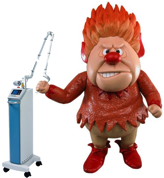
Now I know you’re not a dentist yourself, Santa. But didn’t I hear that one of your elves become part of the North Pole Cavity Patrol? I’ve enclosed a copy of my X-Ray for Dr. Hermey to look at. All I want for Christmas is my four back teeth, one way or the other. Please help me decide what to do, Santa!

Signed,

Blue Christmas Girl               

Filed Under: Operative Dentistry, Research, Technology Tagged With: 3rd molars, BioEden, Cryopreservation, Stem cells, StemSave, wisdom teeth

How’s your hearing?

October 9, 2008 By Trish Walraven 3 Comments

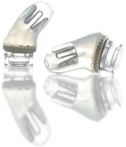
Nice product presentation on the left, don’t you think?

Now what exactly are they? The latest in clear maxillary molar implants?

Wrong. You stick them in your ears. You. The dental professional.  Yes, you, the person who is losing their hearing and doesn’t mind spending about a grand to protect what’s left of your stereocilia.

Not losing your hearing? Then prove it to yourself. Take the test below in a quiet place. Naturally you need to have speakers turned up to about medium to hear all the frequencies. The higher ranges are what are known as the “mosquito” ringtones, which are outside the audible range of people over 30, and often used by the young-uns to send stealth text messages to each other.

There have been a few inconclusive studies published in the dental journals this decade about the concern that high decibel-level noise is an occupational hazard in dental practices. We thought that now would be a good time to gather a little of our own anecdotal evidence, and see how dentists’ hearing stacks up to the general population.

Play     Frequency          Age Range
 8 kHz Everyone
10 kHz 60 & Younger
12 kHz 50 & Younger
14 kHz 45 & Younger
15 kHz 39 & Younger
16 kHz 30 & Younger
17 kHz 24 & Younger
18 kHz 22 & Younger
19 kHz 20 & Younger
20 kHz 18 & Younger
21 kHz 17 & Younger
22 kHz 16 & Younger

Be sure to use your browser’s “back” button to come back to this page each time until you’ve figured out which frequency is your upper limit.

The University of New South Wales in Australia has posted this test if you’d like a more comprehensive hearing exam. And if it looks like your future may be one of geriatric deafness, you might want to give thought to the benefits of a pair of DentalEars.

Filed Under: Operative Dentistry, Products, Research, Technology Tagged With: Dental Ear, dental hearing loss, Hearing aids, hearing test, mosquito ringtones, survey

VR Glasses Revisited

September 7, 2008 By Trish Walraven 2 Comments

You’ve watched way too many movies.

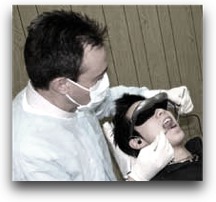
If you’ve got images of Star Trek’s Geordi LaForge, nerdy sidekicks in 80’s new-wave glasses a la John Hughes’ teen films, or the horrors of Total Recall memory augmentation burned into your retinas, then please, let those prejudiced views slide gently outside of your peripheral vision and consider that Virtual Reality glasses may actually be good and cheap enough these days to make them part of your patient comfort collection.

We want to heavily discourage dentists from spending thousands of dollars in wall or ceiling-mounted screens just so that patients can have something to look at besides your ugly mug while you’re fixing their teeth.

We’re not kidding.

The problem with screens like that, during dentistry, is that your head keeps getting in the way while your patient is trying to remain distracted.

There’s lots of other details that can end up complicating the whole thing, so instead of making this a gripe session about overbloated dental amenities, we’ve created a few tracks that will make it inexpensive and easy for you to start using VR glasses in your practice.

Track One: I want it all (hey yeah) and I want it now.

Bank commercials and Queen music aside, you want to have this up and running in your practice immediately.  Here’s the easiest way to get everything you need. Tonight.

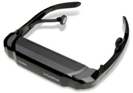
  1. Find your nearest Brookstone store and call them to make sure that they have a pair of these Vuzix™ iWear® AV230 XL Video Glasses ($200, plus tax) in stock. Go get ’em, tiger.
  2. Look through your home collection of DVDs for those with the most appeal over a wide variety of patients. Don’t forget to grab a few of those TV series’ episodes for those shorter appointments as well.
  3. Steal your children’s portable DVD player that they don’t watch in the car anymore because they all have video iPods now.
  4. Buy a bunch of AA rechargable batteries and a recharger, plus alcohol wipes for infection control, and some sort of basket or nice box to keep it all together when moving it from room to room.
  5. Hand over the box of video goodies to your assistant, who will take it all from there.

Cost: Less than $300, unless you have to purchase your own DVD player (around $100) and videos.

Track Two: Keep it simple.

Efficiency is key to this next setup. You want something simple for your team to implement, that will work consistently, and appeal to the broadest spectrum of patients possible, from the 30 minute appointment to the full-mouth rehab. Everything can be purchased online and delivered to your office within the next week.

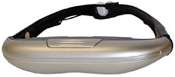
  1. Purchase these 3.5 ounce i-Theater Glasses ($179) direct from the manufacturer, i-O Display Systems. Be sure to add a set of hygienic earbud covers ($20 for 25 pairs) to your shopping cart. The rechargeable batteries are included, as is an AC power adapter.
  2. Get the right kind of DVDs. This is so important. Nothing with a plot because your patients won’t ever want to leave, or worse yet, you’re such a generous dentist that you’ll let everyone take the movies home to finish and then it’s a pain to keep up a decent office library. We recommend instead that you purchase some relaxing, endlessly looping DVDvideos. Our favorites are the Waves Virtual Vacations™ ($10-20), but you may love the music and nature videos at TV Artscapes ($16 and up) just as much. Your patients will want to be in your chair just for the ambience. Seriously.
  3. Oh yeah, you’ll need something to actually play those DVDs, and the ones with the their own screens make it easy for the assistant to get the system set up and running properly. Best Buy has the reliable Dynex® Portable DVD Player ($90) that seems to hold up to abuse and also holds a charge well. You can also simply keep it plugged in with its own AC adapter.
  4. The Box. It is a bit unprofessional to drag the gear and their cords and from operatory to operatory, so we like the Faux Leather Milk Cartons ($34 for two) from Target. They will stay looking good for many years, and are easy to keep clean.

Cost: $400-$500, shipping and tax included.

Track 3: That’s what I pay you for.

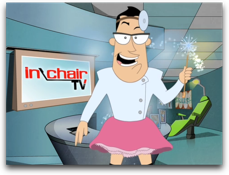
Many of the virtual reality companies directly appeal to dentists to buy their products for patient relaxation and entertainment. MedPED Media has gone several steps further and created an entire package called InChair TV that allows you to relax instead, and leave everything to them.
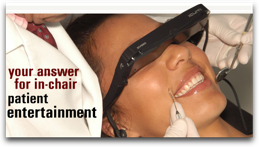
They’ve taken the exact same Vusix™ glasses seen in Track One above and added a Walkman-type portable DVD player.

But then comes the cool part.

InChair TV has gone all Netflix over dentists and not only are they offering a monthly mail-in “rental” system, but inserted between the shows on each DVD are these cute little dental cartoons that advertise services you provide, like teeth whitening and veneers. Each monthly package comes with three 90-minute disks (Kids, Teens, Adults) and all content has been licensed for use in a place of business.

Cost: $518 for the first year (includes all hardware, shipping, and handling), $120 each year thereafter. 10% off when purchasing 3 or more.

_____________

The VR glasses can take a little getting used to if a clinician normally works from the 12:00 position, but otherwise they don’t seem to get in the way much at all. We recommend starting out with one set for the entire practice for a month or so, and if patients and assistants alike rave about your latest high-tech gadget, then go out and get a boatload of them.

This is real proof that slapping an extra zero at the end of a price doesn’t always happen just because a product is branded for the dental market. When there’s a will to make a good product at a fair price, there’s a way.

By the way, did you mean Will & Grace? Good Will Hunting? Or perhaps you’re more into There Will Be Blood?

Maybe you need a pair of VR glasses just for yourself.

Filed Under: Marketing, Practice Management, Products, Technology Tagged With: i-Theater, InChair TV, portable DVD players, virtual reality, VR glasses, Vusix

BrytonPick: Stainless Steel Cleaning Blades

August 26, 2008 By Trish Walraven 9 Comments

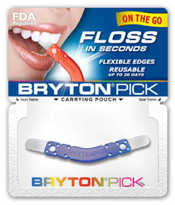
In so many ways, the BrytonPick is the best all-around new product in patient oral health care. 


It’s Green: One pick is reusable for up to 30 days.

It’s Cute: The BrytonPick looks like a little boomerang.

It’s Practical: Patients who absolutely will not use dental floss will be thrilled that a new option is available for food removal. This means they can stop using paper clips, business cards, matches, and fingernails.

It’s Portable: the BrytonPick comes with a credit card-sized carrying case.

It’s Brandable: the back of the carrying case can be printed with the name of your dental practice.

It’s Affordable: BrytonPicks each cost less than $2.


There’s only one problem: It’s made of metal, which makes it hard to watch the video on the BrytonPick website without getting that watery-mouth, galvanic shock sympathy shudder.


Filed Under: Preventive Care, Products Tagged With: BrytonPick, flossing

  • « Previous Page
  • 1
  • …
  • 21
  • 22
  • 23
  • 24
  • 25
  • 26
  • Next Page »

About

DentalBuzz explores rising trends in dentistry with its own slant. The speed at which new products and ideas enter the dental field can often outpace our ability to understand just exactly the direction in which we are heading. But somehow, by being a little less serious about dentistry and dental care, we might get closer to making sense of it all.

So yeah, a tongue-in-cheek pun would fit really nicely here, but that would be in bad taste. Never mind, it just happened anyways. Stop reading sidebars already and click on some content instead.

Recent Posts

  • Dry Humor, Wet Biofilm: A DentalBuzz Look at Periodontal Desiccation Therapy
  • Are affordable online nightguards any good?
  • CareCredit: The Easy Way Billionaire Banks Fill Cavities in Their Profits
  • Off-Label and Totally Legal: What the FDA Won’t Say About Fluoride Varnish & SDF
  • Dentists Rejoice over the Leica Camera Tariffs
  • It’s not OK for your dental practice to use free cloud-based communication
  • Patients ask, “Is it safe to go back to the dentist?”
  • Free “return to work guide” from the American Dental Association
  • Why COVID-19 increases your need for contactless payments
  • A virtual care package from worried dental hygienists
  • Lead Aprons feel so good! Here’s why.
  • What is this $&!% on my toothbrush?

Article Archives

Contact Us

Guest columnists are welcome to submit edgy stories that cover new ground (no regurgitations, please!) , or if there's a topic that you'd like to see explored please punch in your best stuff here and see if it ends up sticking to the website.

Follow DentalBuzz on Social Media

  • Facebook
  • Instagram

DentalBuzz Copyright ©2008-2026 • bluenotesoftware.com • All Rights Reserved