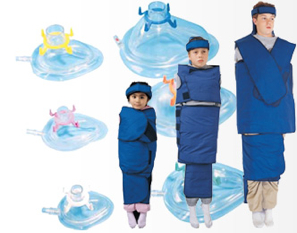
 No one likes the idea of seeing a child being restrained. Especially not at the dental office. But on the same hand, if a child is admitted to a hospital, has thousands of dollars spent to knock them out with potentially risky gas, and is in need of a procedure that takes only minutes to perform, which care is the right one?
Notorious press has given the papoose board a bad name. Granted, its utilization can be abused, especially as seen in the story that was profiled on ABC’s 20/20. General anesthesia isn’t without its opponents as well, especially when a child dies.
With that somber note hanging in the air, you may want to revisit David After Dentist and pick yourself up with a little sedation dentistry humor. Even if you don’t agree that his dad should have ever posted the video on YouTube, it’s still so freakin’ funny.
Children who can’t be cooperative still need a means of getting their dentistry done, so pedodontists must make choices that sometimes include the use of papoose boards or general anesthesia. For entertainment’s sake, let’s just call this polarizing dilemma by another name: Hugs vs. Drugs.
| Hugs | Drugs | |
| Familiar name | Papoose board restraint | “Knocked out with the mask” |
| Kinder-sounding euphemism | Protective stabilization | Inhalation anesthesia |
| Risks |
|
|
| Benefits | Can be used quickly and inexpensively without much training | Instantaneous and complete patient control |
| Perception | Brute force and inhumane treatment seen in Medicare clinics | Clean, modern care paid for by inscos and private payer |
There have been accusations from both sides: allegations of “nest feathering” by morally outraged dental anesthesiologists, abuses of public funds to pay for unnecessary procedures, the ultimatums given that any child restraint is considered grounds for lawsuits, equating papoose boards with third-world dental care, or offering general anesthesia for simple extractions when a combination of restraint and other sedation would be less expensive and as effective.
As a dental professional, it is your responsibility to make well-informed choices about sedation and restraint methods. For instance, individuals with autism or cerebral palsy may find that restraints are not only necessary, but even welcomed when compared to the use of drugs that can do more harm than the good that the dentistry is trying to achieve. Restraints may not be a better choice for toddlers whose biggest problem is a helicopter parent or two who are freaked out about the psychological trauma of having an irreparable tooth pulled. If a parent freaks, most likely so will the child, so it may be your choice to pander to the whiny world of children who are more in charge than their parents. After all, it’s no big deal to go under GA for a five-minute ear tube procedure with the ENT, right? That’s expected.
No matter what you decide to do, as long as you’re doing it from a level of comfort with your ability, and most importantly, from a sense of compassion, you should be able to confidently make the call for each patient, no matter where it falls on this line.
But sometimes, you just want to throw up your hands and say “AHHHHH I QUIT!” because you don’t know how to manage a patient. That’s when it’s awesome to have someone in your contact list who you trust to make this call.
And then pass the buck to them, because referring out can be very, very gratifying at times.
Valuable info. Lucky me I found your site by accident, I bookmarked it.
This is a really hot button issue for a lot of people, as I’m sure you already knew. However, it would seem to me that in many cases, the papoose board would be a preferable thing to general anesthesia for a child who may or may not come back up. In any case, I think that it’s a choice that needs to be made on a case by case basis, with sedation and local anesthesia used in conjunction with the papoose board to create a safe, sane situation for everyone involved. If the child needs the procedure and general anesthesia is too dangerous, then a papoose board is obviously a good choice. However, if the dental situation is not an emergency, then I think that waiting till the child is old enough to not need the papoose board should also be looked at as a viable option.
Donald from Tooth Extraction Pain How Long
Very interesting article and appreciated that it is coming from someone from the dental field.
This is definitely a very hot topic and the healthcare field really needs to do a better job at finding a national standard procedure on when to use a papoose or any type of physical or chemical restraint. There are so many gaps of information that is not documented on when a physical restraint is used and it saddens me to see that there is even less documented when it comes to the care of children. I sure hope those people in pediatric medicine keep their promise of ‘doing no harm’ to ALL of their patients. And remember doing no harm involves no harm both physically and mentally.
my autistic son was given the SCIP maneuver today. What is this – how safe is this procedure
My almost-3-year-old son will be getting an injured tooth extracted next week. (By the way, I found this Mom’s Guide to be a helpful tooth resource for us.) My son is not cooperative AT ALL and we briefly considered the papoose for this procedure. He is extremely fearful of the dentist (nice intro to dental care- having a tooth injury last fall!) and he will not allow the dentist or hygienist to do more than a quick peek in his mouth. I think if he was older and we could explain this to him in a way he could understand we would be more likely to use the papoose. But we’re setting his dental foundation here, so this time we’re opting for light sedation, done in a board certified pediatric dental office.
It’s nice to read such a detailed, unbiased comparison. Personally, my son needs the anesthesia when he goes to the dentist. He freaks out at just the thought of going.
buenos dias les escribo por que estoy interesada en un papoose board para la clinica en la que trabajo, vivo en Colombia Bogota, y quiero saber como puedo hacer para conseguir uno, gracias
Sorry, don’t know where to get them for your clinic. But thanks for the opportunity to use Google Translate (since 3 years in high school Spanish went down the drain!).
Thanks for the detailed explanation and comparison. I went to your link on the ABC 20/20 news story and it is just shocking! These dentists are operating a torture chamber, or not far from it, in order to increase their profit.
And it is sad that these dentists are exploiting parents who are limited by their choice of dentists due to their income level.
Thanks for putting this to our attention.
My autistic children get wrapped in the restraining board when they have extractions or cavities drilled. My 5 year old actually smiles and looks forward to being “wrapped like a mummy” and my daughter tolerates it. I prefer this to sedation for simple procedures. Some young children, and especially autistic young children, will not stay still otherwise. Sedation is not more humane, it’s a dangerous undertaking that should be reserved for extensive oral surgeries that will involve prolonged time in the dentist’s chair.
“Restraints may not be a better choice for toddlers whose biggest problem is a helicopter parent or two who are freaked out about the psychological trauma of having an irreparable tooth pulled. If a parent freaks, most likely so will the child, so it may be your choice to pander to the whiny world of children who are more in charge than their parents.”
So if a parent does not want their child restrained, this is the kind of judgment passed on them by dental professionals?
Wow.
Kristie, unfortunately the answer here is often yes.
You CANNOT do that to a child. It was done to me. I was traumatized for 30 years and only realized WHY two weeks ago. I do not know how long I will be fighting to heal from the terror, humiliation, and misery.
Do not restrain a child. If they do not agree to the procedure, LET THEM DIE if that is the alternative. IT IS NOT WORTH PUTTING THEM THROUGH IT!!!!!
I was tortured. Do not torture your child. Please.
I find it odd that you only give these two choices. Restaint for dental care is inhuman and cruel. If restraint is so necessary, why is it illegal in every other developed country in the world? Also, if the dental care is presented in a caring and calm fashion at the child’s pace, sedation is not needed either. The way to deal with children is to introduce them to dental care in a calm and sympathetic way, slowly. Unfortunately, our denal profession only cares about money and time is money. The dental profession in the US is a disgrace
I agree with you up to a point. However, if a three-year-old is writhing in pain caused from a dental abcess and there is no way to compassionately convince the child to calm down in order to alleviate that pain, what other options do you know that are available? It’s been my experience that young children usually do not logically respond to a clinician’s peaceful demeanor when their mouth is hurting. We have never used restraint or sedation methods in our office other than nitrous oxide, but even it is only useful for kids who will relax on their own, otherwise they are referred to a pediatric dentist who has more options available.
Everyone likes to hate on dentists, until they need one. A loved one is a dentist, and works his ass off. He treats every client with love and care. About the money? He went to school for 12 years!!!!!!! He has been trained and trained and trained, and he doesn’t deserve to make a few dollars?! Sorry, this isn’t McDonald’s. Pediatric dental care is a touchy thing because of parents always knowing more than the person who actually know what they’re doing.
This compared the board and nitrous. What about conscious sedation using oral medication?
I have PTSD from being restrained at 3. It is my earliest memory. It was terrifying and has given me life long issues with any covering, even blankets.
You are not alone in that
I would like to see a more educated view in regards to the inherent risk of anesthesia. With an appropriately trained anesthesia provider (be it MD, DO, DDS/DMD or CRNA) who is NOT simultaneously attempting to act as the operating dentist the author of this blog drastically overstates the statistical probability of morbidity/mortality due to sedation/anesthesia. I understand this is done in an attempt to justify the potential for a debate between the two models of care. Unfortunately, it stresses the significant lack of knowledge regarding the causes of well published injury/death occurring within the dental office setting. Whether it be Caleb’s law (www.calebslaw.org) arising from the inadequate training of oral surgeons in regards to anesthesia or the questionable decision of a well trained, experienced MD anesthesiologist who attempted office based general anesthesia on a 14 month old child in Austin, TX … anesthesia morbidity/mortality does not appear w/out a cause and effect relationship. Unfortunately the cause is inadequate standards of accepted care and/or inadequate training of dentists/oral surgeons who attempt deep sedation. Simple facts are often the hardest to recognize and I urge any reader of this blog to do their due diligence.
I was traumatized terribly because of Papoose boards so only used them if you are willing to shell out money for the therapy they will need and are willing to own up to what you did to them. Even a little over 20 years later I still feel the effects of them. It is inhuman to treat a child or even an elderly person like this.
If anyone is still on here: I’m equally glad I found this thread and equally sad there are other people who also deal with the hell of PTSD from childhood use of papoose board at the dentist. I was 3 when it happened, I’m 30 now. I have night terrors from it, flashbacks, crippling anxiety, and can’t have blankets on me. I don’t know where to begin to heal myself from it