
• Archives
  • Products
  • Operative Dentistry
  • Dental Team Communication
  • Practice Management
  • News
  • Research
  • Dental Debates

DentalBuzz: a jolt of current

trends, innovations, and quirks of dentistry

  • Home – Latest Buzz
  • Bloglist
  • Indie Dental Showcase
  • Free Dental Timer
  • Practice printables
  • Podcasts

I got a potty mouth

July 21, 2008 By Trish Walraven 4 Comments

Hi. I’m a very sad American Indian. I am crying because I just learned that my children have Bisphenol-A in their dental sealants. BPA is bad. It means my boys might end up with man-boobs.

This is about dental pollution, people. It may be ignored by mainstream science, but this problem is real enough to sell newspapers, magazines, and make you read online articles.

What I’ve Heard About Dental Pollution

Everywhere I go I hear about how it’s not fair that the citizens of cities have no choice about the fluoride in their drinking water. Sure, it makes teeth stronger, but there’s a conspiracy of pollution! And it’s the people who are so poor that they can’t even afford cups, they have to tilt their heads sideways to drink under the sink faucet, they are the ones who get the most fluoride in their bodies.

Does fluoride save lives like chlorine does? Wait, I didn’t say that, because it’s going to sound like I am in favor of putting poisons in the water.

You dentists also are protecting the right to fix the holes in people’s mouths with evil substances. If you drill a tooth and put in a silver filling, you have to make the filling soft with toxic mercury. Why can’t you just heat up the silver and pour it in the cavity?

The high road dentists are no better, with their lady-man BPA-leaching plastic composites. I’d rather gnaw on a Nalgene bottle and take my chances with it than have an oil-slick wedged between my teeth 24/7.  The recent petroleum price increases are nothing compared to the cost in human lives.

The other thing that’s polluting our mouths is lead. There’s been lead found in ceramic/metal crowns. They say these crowns come from China. We like to blame everything on China.  But the real reason that there’s lead coming from the dental labs is because the cheap dentists have forced lab technicians to scavenge for scrap metal by secretly dumpster-diving for X-ray film packets.

My shaman tells me that all the metal he sees in people’s mouths is creating imbalance in their meridians. This pollution is caused by all the various metals sending out galvanic currents, which turns our mouths into electrolyte-driven batteries. It scares me even today when I see that trick with the guy who sticks the end of a lightbulb in his mouth and it turns on. I know he’s dying from galvanic currents just for a laugh.

One more pollutant that is caused by the well-meaning but unenlightened dentists of the world is when they leave a dead tooth in a living mouth. Would you leave a cadaver just laying around with living people? Well, this is just what is done when a dentist fills the root canal of a tooth and just leaves the dead shell of a tooth in place.

I’m no Navajo with my sand art, but I sketched out this modern flow chart to help us understand where all this pollution is leading:
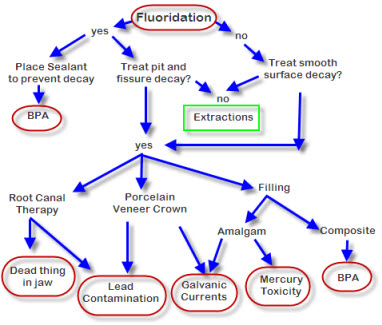
The pollutants are circled in red. Only one treatment is circled in green because it doesn’t involve dental pollution.

With only two choices in life if we find that we need a dentist – a polluted mouth or the totally toothless gums of a baby – all we can do is pray to our ancestors to give us naturally strong, healthy teeth.

My life has been one of ignorance until now. I have been going to the dentist regularly, and have had various pollutants placed in my mouth. I still have all of my teeth and have no ill symptoms from the poisons. Should I be grateful, or should I be worried? Are teeth worth it, in the end?

Six Degrees Of Dental Pollution

Here are various tests that you can either do in your office or send home with patients to make sure that you aren’t polluting their mouths:

Fluoride: http://www.hach.com

Bisphenol-A: http://www.biosense.com

Mercury: http://www.heavymetalstest.com/_hgkit.php

Lead: http://www.zefon.com/store/leadcheck-swabs.html

Galvanic Currents: http://www.biomeridian.com/devices.htm

Root Canal Therapy: http://www.holisticdentist.com/articles/root-canal-treatment.html

I know that this isn’t Keep America Beautiful or any other grand public service announcement, but it’s important for dentists to understand the consequences of their actions. And sorry about the waterworks; you know how pollution is a touchy subject for me.

Filed Under: Anecdotes, Dental Debates, Featured, Research Tagged With: BPA, Composites, Fluoride, Galvanic currents, Lead contaminated crowns, Mercury Toxicity, Sealants

Consumer Reports: What, no bill’em?

June 20, 2008 By Trish Walraven 3 Comments

Unbiased reporting about the consumers themselves.


It may be hard to believe, but patients all over the country are complaining that dentists aren’t asking them to pay their bills anymore.

For many years, consumers have taken advantage of dental practices’ good will by just “paying when they could” for their dental care. Unfortunately for many offices, this resulted in the expenses of staff time, mailing repeated statements, and simply writing off debts that were never paid.

Now that healthcare financing has come to the market, Consumer Reports (July 2008 issue) is pointing fingers at CareCredit, the Citi Health Card, Chase HealthAdvance, CapitalOne Healthcare Finance, and the dental providers themselves for allegedly taking advantage of the doctor-patient relationship.

There is no excuse for dentists who purportedly sign patients up for these programs while sedated, or otherwise abuse their patient’s credit for personal gain. Consumer Reports makes it seem like the American Dental Association itself condones this type of behavior. The purpose of healthcare financing is to benefit patients, dentists, and the participating banks. The article even affirms that the lenders take anywhere from 4.5% to 13.9% of the fees that are financed through their credit cards, which is much, much higher than traditional credit cards. Dentists pay these fees in order to give patients access to interest-free payments.

Most patients do pay off their balances within the interest-free period. Those 20 percent who do not were originally the kind that were most likely to show up in the dentists’ accounts-receivable column at the end of the year. Only now it is the banks who have accepted the burden, and because contracts are involved, so are consequences.

Is it really the dental equivalent of subprime mortgages?

Consumer Reports seems to think so. While not exactly an adjustable-rate mortgage, the default retroactive APR of 22.9% when a balance isn’t paid in full after 24 months is not news to anyone who reads the fine print on any typical credit card statement. The only money crisis in healthcare lending is that consumers are now being held accountable for their actions.

It is our culture that breeds the opinion that consumers deserve what they want, exactly when they want it, and it is this belief that is the underpinning of excessive consumer debt. Most patients want a perfect smile, but only the ones who don’t have the self-discipline to know whether or not they can even afford the payments are the ones getting snagged by the banks.

In defense of Consumer Reports, however, it does appear that some of the terms of the loan agreements are difficult to stomach, and it is agreed that some reform here would be beneficial to everyone involved.

Many consumers believe that teeth are more of a luxury than a life-and-death issue. Affirming this is the prosperity of quality dental practices which do not rely on insurance payments for their livelihood. And the bottom-line truth is that edentulism is not a risk factor for any other diseases, so it is not a liability to the overall health of a patient.

Dental insurance is a form of consumer entitlement, and healthcare financing is one strong step away from this dependency and expectation. Insurance justifies the acceptability of mediocre dentistry to the consumer. Perhaps the reality is that every dentist should move towards the model of providing excellent dental care at fees that will keep them in business, without taking advantage of those patients who need much more than just a good set of chompers in their lives.

What’s next?

Our prediction: haircare financing.

Filed Under: Dental Debates, Money, Practice Management Tagged With: CareCredit, Consumer Reports, dental crisis, dental insurance

inTerra – better than stumps

June 1, 2008 By Trish Walraven Leave a Comment

In our last episode, we left as the two camps bickered over what they were going to do once they had actually tracked down the elusive Maxillus mandibularis. The leader of Camp NeuroMuscular had leaned toward the fire, cradling the bowl of his pipe in his fingers and clenching its stem in his teeth like an NTI device. Removing the pipe, he suggested that the solution was to deprogram this infernal beast.

“Nonsense!” replied Sir Centric Relation from under his handlebar moustache. “Everyone knows that you must guide the cuspid. It is the only way to stop the nightly rampage.”

As we return to the scene, Sir Centric stands up and peers into the encroaching darkness.

“But ho, what is this?” Out of the shadows steps a keen-eyed gentleman in a light blue seersucker suit and an obvious combover.

The man approaches the fire and begins his spiel. “You know what is the real problem, right? You just want to keep the Maxillus mandibularis from crashing in here and destroying everything. Do you think all those villagers care about why? They want this problem fixed, and they want it fixed today.”

The gentleman swiftly rolls out a sheet of something, squishes it around the beast’s water-hole, and waits for it to harden.

“There ya go. Problem solved. And it’ll cost you less than having those timberlogs dragged in from the forest. Besides, who has two weeks?”

“Certainly that shouldn’t be a problem. The villagers have been living with this for years.” says the leader of Camp Neuromuscular.

“Yes, but they came to you today for an immediate solution.”

“It’s only a stopgap. It doesn’t correct the underlying problem. And eventually the barrier will fail,” chime in the leaders of both camps.

The gentleman brings his fist up to his chin in thought. “Well, even if you can kill the beast, you do realize that it’s a protected species.”

“But no way is it in danger of going extinct. It must be laid to rest!”

“Yet, still so hard to kill quickly. Goodnight gentlemen. If you change your mind, just ask around. Everyone in these parts knows where to find me.”

The man in the suit slinks back off into the darkness, leaving the two leaders alone in silence, once again glaring at each other from across the campfire.

*********

When it comes to parafunction that eventually will whittle your patients’ teeth down to stumps at night, it only makes sense to fabricate some sort of cushion to soften the blow. Dentsply-Caulk has recently been advertising the inTerra iNoffice Nightguard. This product appears to break down some of the obstacles that come up as the dental profession seeks to eradicate bruxing from the planet.

The iNterra Nightguard’s VLC (visible light cure) material is packaged in three arch sizes. This soft tray is formed directly on the patient’s teeth while in the chair, tack cured in the mouth for a few minutes, and then completed in the lab in another 20 minutes, which makes same-day delivery a snap.

With an existing light-curing oven in your lab, the cost to begin fabricating nightguards in-office makes the iNterra system a decent value, cutting the usual lab fees for nightguards at least in half. Otherwise, be prepared to spend a few thousand dollars on a curing unit before you insert your first case.

Look at the iNterra Nightguard from an efficiency standpoint. Single appointment, no lab transportation issues, minimal doctor chairtime. You may also be able to improve case acceptance when passing on the reduced overhead costs to patients.

Is it the best way to prevent occlusal wear? Who’s to say? But the inTerra Nightguard is much better than doing nothing about parafunction.

Filed Under: Dental Debates, Preventive Care, Products Tagged With: appliances, humor, InTerra, Nightguards, NM vs CR debate

  • « Previous Page
  • 1
  • …
  • 3
  • 4
  • 5

About

DentalBuzz explores rising trends in dentistry with its own slant. The speed at which new products and ideas enter the dental field can often outpace our ability to understand just exactly the direction in which we are heading. But somehow, by being a little less serious about dentistry and dental care, we might get closer to making sense of it all.

So yeah, a tongue-in-cheek pun would fit really nicely here, but that would be in bad taste. Never mind, it just happened anyways. Stop reading sidebars already and click on some content instead.

Recent Posts

  • Dry Humor, Wet Biofilm: A DentalBuzz Look at Periodontal Desiccation Therapy
  • Are affordable online nightguards any good?
  • CareCredit: The Easy Way Billionaire Banks Fill Cavities in Their Profits
  • Off-Label and Totally Legal: What the FDA Won’t Say About Fluoride Varnish & SDF
  • Dentists Rejoice over the Leica Camera Tariffs
  • It’s not OK for your dental practice to use free cloud-based communication
  • Patients ask, “Is it safe to go back to the dentist?”
  • Free “return to work guide” from the American Dental Association
  • Why COVID-19 increases your need for contactless payments
  • A virtual care package from worried dental hygienists
  • Lead Aprons feel so good! Here’s why.
  • What is this $&!% on my toothbrush?

Article Archives

Contact Us

Guest columnists are welcome to submit edgy stories that cover new ground (no regurgitations, please!) , or if there's a topic that you'd like to see explored please punch in your best stuff here and see if it ends up sticking to the website.

Follow DentalBuzz on Social Media

  • Facebook
  • Instagram

DentalBuzz Copyright ©2008-2026 • bluenotesoftware.com • All Rights Reserved